
About Adult Development & vertical OD
Vertical OD….Working inside out and outside in
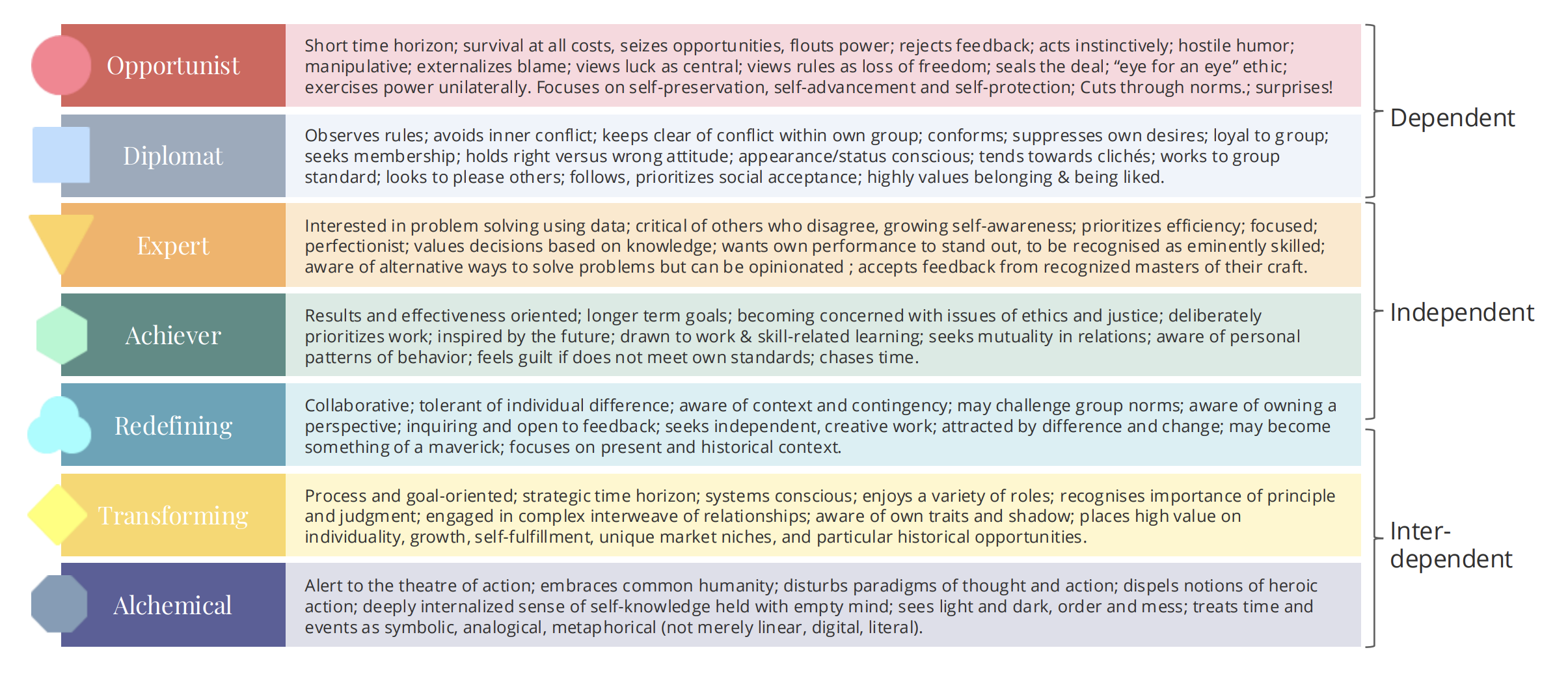
In vertical OD, we take many of the ways in which other organizational analysts or theorists understand organizations, and we add the element of action-logics or worldviews. We do this to deepen our understanding and to link organizational development to human development.
While we may get to things in a slightly different way, our approach very much builds on the work of organizational theorists like Schein, Argyris and Schon.
We know that what we see in an organization is not just random; it is based on deeply held collective beliefs, named basic assumptions by Schein and understoood as our worldviews or action-logics by us. While much of our work on action-logics and worldviews has been focused on 1st person work (self), we also see this playing out in 2nd person (others) and third person (systems) too.
Like our personal action-logics these organizational action-logics in 3rd person are fluid. Rather than expecting an organization to have one static action-logic which is pervasive in every department and team and for any dimension, we can expect to see variety. This means that as OD practitioners we need to pay attention each time we encounter the organization, to notice the worldview for different parts of the organization, or with regard to different attributes. Our worldview on power may be different from that on time or conflict.
We may be curious about which worldview the sales department holds, or which holds them, and how those relate to the worldviews of the production or finance department. We notice visible signs. By looking at both what is inside that creates the visible signs and the visible signs themselves, we can build a deeper understanding of common traits and differences. While organizations, often against their own better judgement, tend to focus on changing the external artefacts, vertical OD focusses on understanding the worldviews at work. Using double and potentially triple loop learning to test and shift assumptions that are part of these worldviews.
By looking at the organizational worldviews as they show up in different parts of the organization, and with regards to different attributes, we get an even deeper understanding of the processes creating the organizational cultural dynamics. And this also offers more options to intervene.
By Systke Casimir