

Welcome to CultureInsights
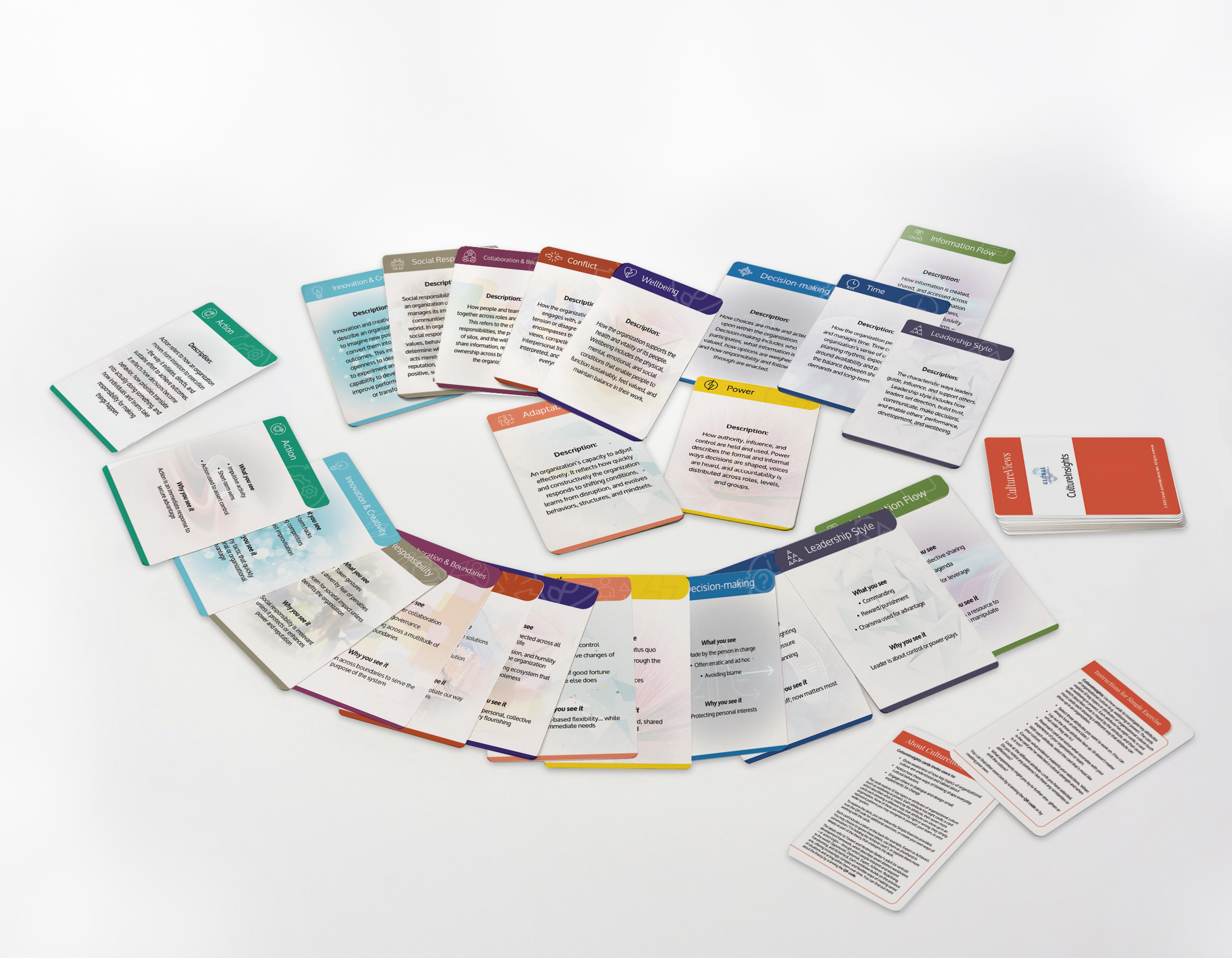
CultureInsights cards invites users to:
• Grow awareness of how key topics of organizational culture are understood and talked about
• Notice how these ways of thinking shape everyday cultural behaviors
• Engage others in dialogue and design small experiments for change
The cards explore 12 key topics or attributes of organizational culture (such as wellbeing or power). Each attribute has eight cards; a card which describes what is meant by the attribute, then seven more cards each showing a different way that attribute can show up in an organization. None of these are inherently right or wrong; they simply represent patterns you may recognize in yourself, your team, or your wider system.
To explore the deck, you can follow the simple exercise provided in the deck or create your own ways of working with the cards.
Understanding the labels
Each card includes a label on the back (for example, Expert or Achiever). You may choose to ignore these labels, use them as shorthand in conversation (“I’m holding the Achiever card”), or explore them more deeply as part of the theory that underpins the deck.
The labels refer to Torbert and Herdman-Barker’s adult (or vertical) development framework, which describes seven distinct worldviews – or action logics – through which people interpret and respond to the world: Opportunist, Diplomat, Expert, Achiever, Redefining Transforming, and Alchemical. Each worldview builds on the previous one, offering increasingly complex and flexible ways of making sense of situations and acting within them over time.
How to choose the attributes
This work has been a process of action-inquiry, both with our clients and the world around us, and between ourselves. We started this work with a list of attributes that we knew might be important in organisations. As we interviewed people in the field, debated between ourselves, and looked at theorists, some fell away while others emerged. We guessed what might work, surveyed, tested, tried and then stepped back and reflected. All the while we were looking for attributes that would work for you in the room.
The twelve attributes we chose came out of this process and now go into the next phase of action-inquiry in the rooms of clients. Together we’ll discover which are used most, which we sorely miss, and which surprise us. From that we may adapt and change them in the future. Whilst imperfect, we hope they are helpful.